House Clearance Regents Park: Recycling & Sustainability
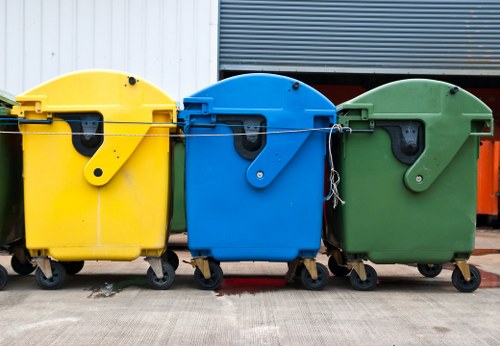 House Clearance Regents Park services are increasingly focused on creating an eco-friendly waste disposal area and a genuinely sustainable rubbish area across the neighbourhood. Our regents park house clearance initiatives prioritise reuse, repair and responsible recycling over disposal. We work to reduce the environmental footprint of every clearance by diverting materials from landfill and supporting local circular-economy projects. This page outlines our clear targets, local partnerships, transfer station routes and vehicle strategy so clients understand how a House Clearance in Regents Park can be both practical and planet-positive.
Our approach to regents park clearance is built on three pillars: prevention, separation and responsible processing. At collection we sort items on-site into designated streams — furniture for reuse, textiles, WEEE (electricals), metals, glass, paper/card and residual waste. We follow borough approaches to waste separation where relevant: many neighbouring boroughs operate separate food, glass and mixed recycling collections, and we mirror those separations to ensure materials enter the correct municipal or third-party recycling systems. By separating at source, we increase recovery rates and improve the quality of recyclates sent to materials recovery facilities.
 Recycling percentage target: our company-wide target is to achieve an 85% recycling and reuse rate for all house clearance jobs in the Regents Park area within the coming year. This target is ambitious but realistic: it combines direct reuse (furniture, fixtures), donation to charity partners, and delivery to local authorised recycling and transfer stations. We publish quarterly diversion figures internally and work with partners to improve the performance of the whole waste chain.
Local transfer stations and processing facilities
To maintain an efficient and transparent eco-friendly waste disposal area, we route separated loads to licensed local transfer stations and processing centres. Key transfer hubs we regularly use include the North London transfer stations such as Hendon Transfer Station and Edmonton EcoPark materials facilities, plus nearby municipal Materials Recovery Facilities (MRFs). These sites accept segregated streams and maximise the value recovered from glass, paper, metal and mixed recyclables. Where appropriate we also use designated bulky-waste facilities for safe processing of large items.
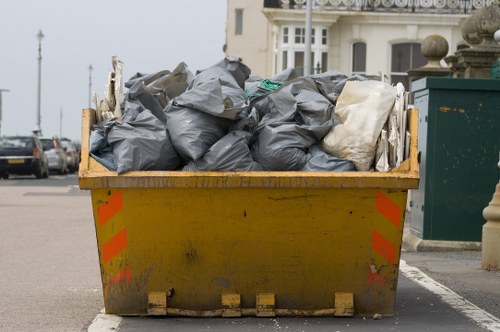 Partnerships with local reuse centres and charity shops are central to sustainable rubbish area outcomes. We have formal arrangements with several charities — local furniture reuse organisations, community housing projects and national charities operating in London — to take good-condition sofas, beds, tables and working appliances. Examples of typical charity partners include community-focused reuse charities and national outlets that collect furniture for people in need. Donated items are inspected, repaired where possible, and offered to households on low incomes or redirected to social projects.
In addition to charities, we coordinate with local social enterprises that specialise in textiles and WEEE recycling. Smaller items, like books and kitchenware, are often sorted and transferred to community reuse hubs. This approach reduces landfill, supports local social causes and strengthens the local circular economy for House Clearance in Regents Park.
Low-carbon vans and sustainable transport choices
Our vehicles are a visible part of our sustainability promise. We operate a mixed fleet focusing on low-carbon vans — including electric vans, plug-in hybrids and Euro 6 low-emission diesel vehicles for longer routes. Transitioning to low-emission transport reduces local pollution in central London and lowers overall carbon intensity for each clearance job. Where jobs are clustered in nearby streets, we consolidate collections to reduce mileage and improve operational efficiency.
 We maintain strict loading and route-planning protocols to ensure that our regents park house clearance runs minimize idling and unnecessary travel. Drivers are trained in eco-driving techniques and our scheduling system prioritises back-to-back pickups to make best use of capacity. The combination of cleaner vehicles and smarter logistics contributes directly to a sustainable rubbish area and a smaller environmental footprint for every clearance.
 Key recycling activities we regularly manage for clients include:
- Furniture reuse: inspection, light repair, and donation to charities or resale through reuse centres.
- WEEE recycling: safe segregation and delivery to WEEE-approved processors for TVs, computers and white goods.
- Textiles and soft furnishings: sorted for reuse or textile recycling streams.
- Metals and hard materials: compacting and transfer to metal recyclers and MRFs.
- Paper, cardboard and glass: baling or direct delivery in line with borough separation standards.
Monitoring and continuous improvement are core to delivering an effective eco-friendly waste disposal area for House Clearance Regents Park. We track tonnages by stream, measure reuse outcomes, and audit our charity and transfer station partners to ensure proper processing. Regular reviews of collection practices and vehicle performance allow us to refine routes, reduce contamination rates and improve recycling percentages over time.
We also engage with local borough waste teams to stay aligned with municipal recycling policy. Both Camden and Westminster have robust kerbside recycling schemes and growing food-waste collections; by aligning our internal sorting rules with borough guidance we make sure materials diverted from house clearances fit into the wider system. This cooperation helps create a neighbourhood-level sustainable rubbish area that complements municipal services.
Finally, our commitment to the community is not just environmental but social: by prioritising reuse, partnering with charities and operating low-carbon vans we support social outcomes while shrinking the carbon footprint of each Regents Park clearance. For anyone planning a regents park house clearance, choosing a service that emphasises sustainable, certified disposal routes and charity partnerships is the best way to ensure a positive outcome for people and the planet.